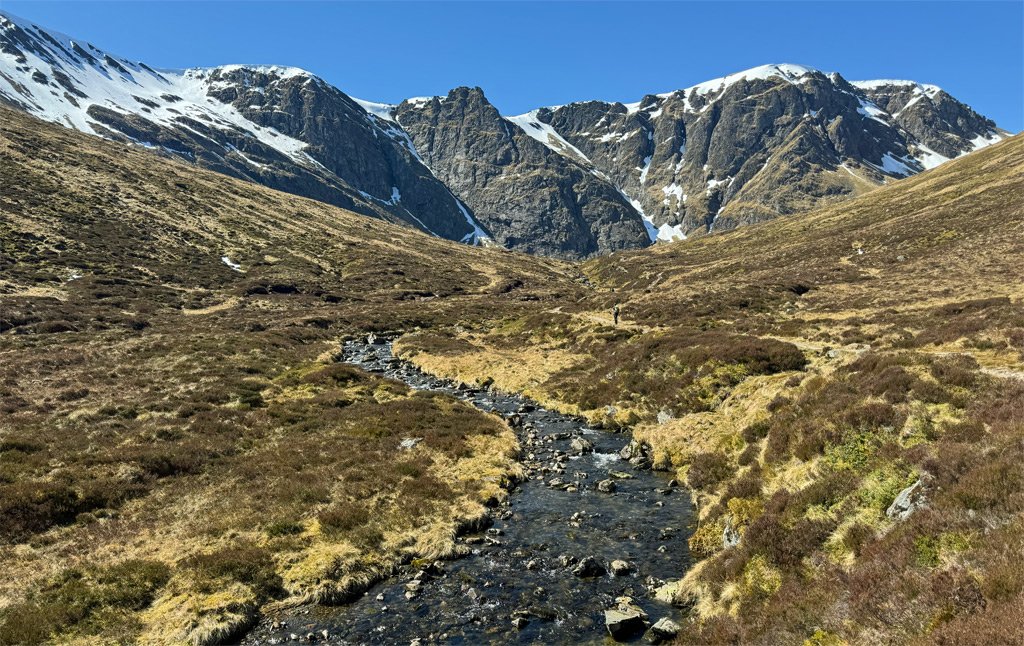
Creag Meagaidh is seen by many to be a mountain preserve for ice climbers, skiers and winter walkers, and indeed, under its customary white mantle, the mountain is undoubtedly at its finest.
However, there is also much to recommend for the summer visitor, from the extraordinary natural regeneration of the landscape and the secluded splendour of one of the most magnificent Highland corries, to the expansive freedom of the summit plateau.
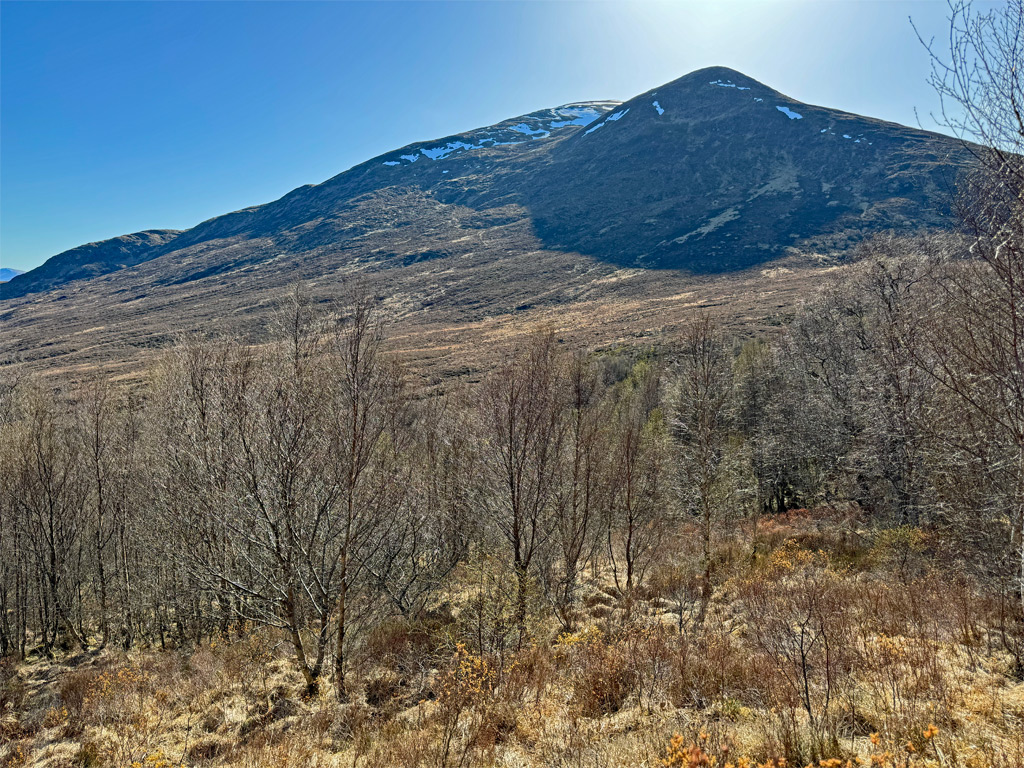
Creag Meagaidh is a lofty height. At 3701ft (1128m), it is the 29th highest Munro and, more significantly, the 12th greatest in prominence. Nevertheless, from a distance, the mountain merely resembles a vast, rather undistinguished mass. This might well deter the casual walker, especially one unaware of the mountain’s magical, defining, yet concealed corrie.
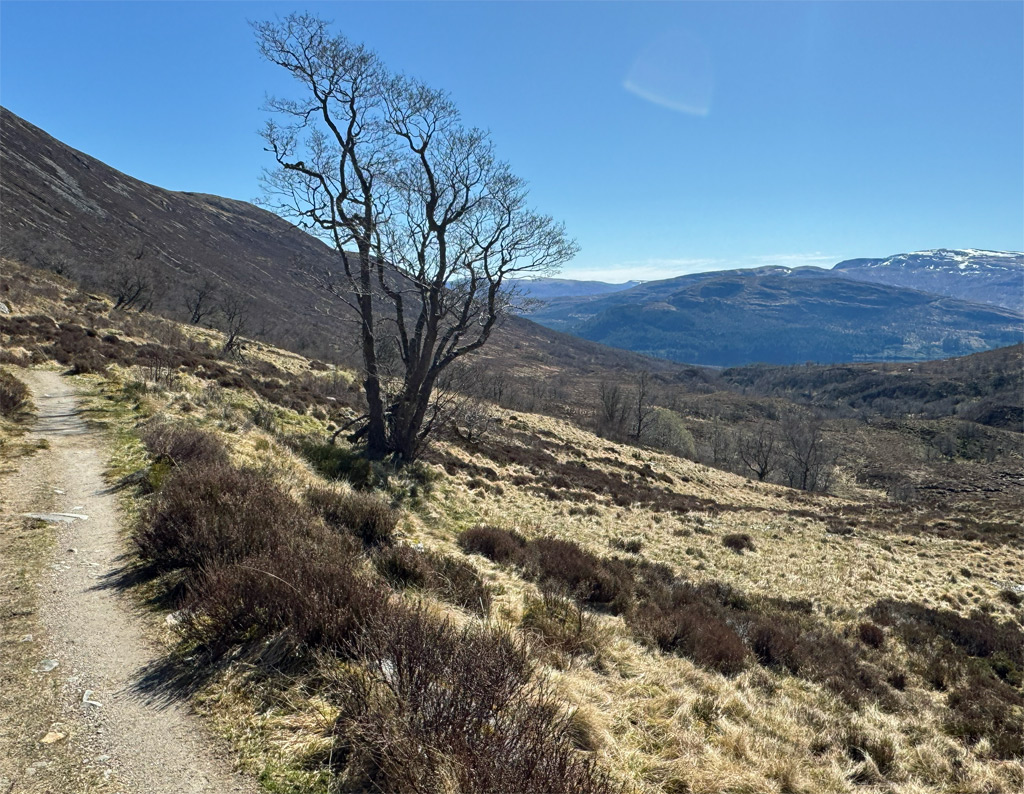
The importance of Coire Ardair cannot be overstated; nonetheless, the National Nature Reserve status and its associated landscape qualities are an integral part of the mountain’s appeal. The reserve extends from the summits to the shores of Loch Laggan, enclosing an astonishing variety of habitat, and some knowledge of this greatly enhances a visit.
Historically, Creag Meagaidh was Clan Macpherson land, which also included the Ardverikie Estate, whose resplendent baronial castle lies on the shores of Loch Laggan. Ardverikie was seriously considered as a potential royal residence by Queen Victoria before she was reputedly persuaded that the weather was somewhat drier on Deeside, and the site of Balmoral was chosen instead. If not, Creag Meagaidh rather than Lochnagar would have become the favoured royal mountain.
The land hereabouts was sold in 1983, with the aim of afforestation blanketing the hillsides up to a height of 2,000ft. However, the Nature Conservancy Council recognised the significance of the habitat, despite much of it having been decimated by overgrazing from high deer and sheep numbers. The bold plan was to enable the landscape to revert to nature. It was bought back and, in 1986, became a National Nature Reserve.
The regeneration of natural woodland has been a huge success, achieved through reducing sheep from nearly 500 to around thirty (most of those having sneaked in from neighbouring farms) and limiting deer numbers (reduced from over 1,000 to around 250). It’s a remarkable fact that no seeds have been planted; the regeneration has been entirely natural. Another benefit has been a large influx of birds attracted by the regrowth of the natural habitat.
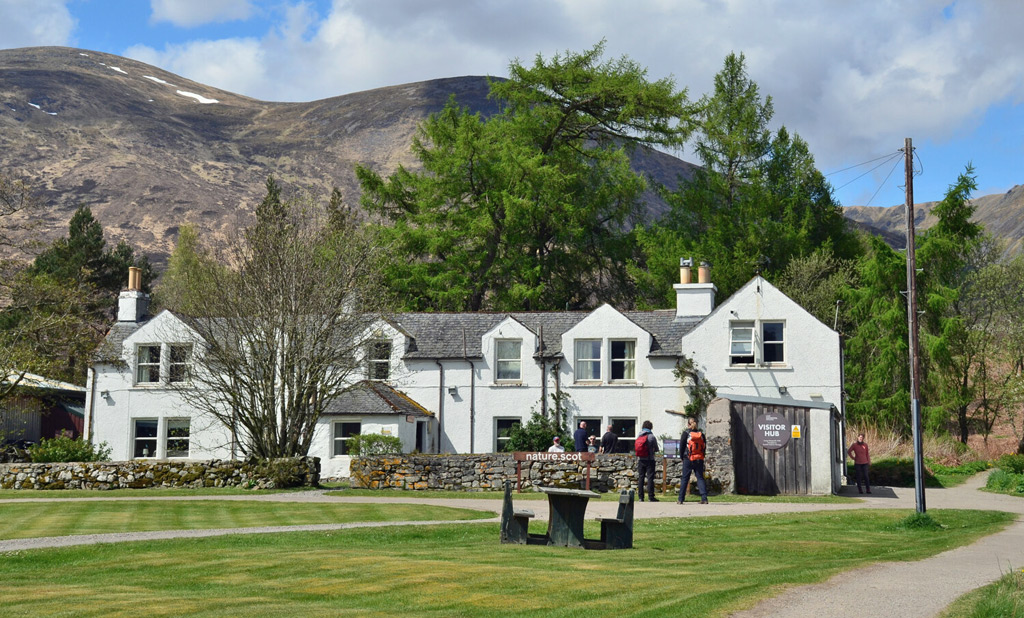
Some 10,000 visitors a year come to explore the nature reserve, most staying low on the mountain on trails created around the visitor hub at Aberarder. This is also the starting point for the majority of ascents of Creag Meagaidh.
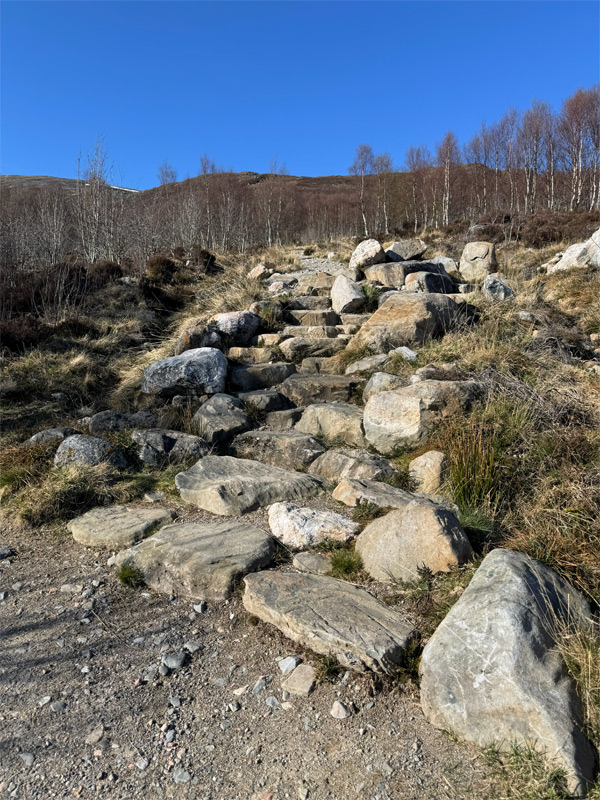
The ‘standard’ walkers’ route takes a thirteen-mile circuit of three Munros: Creag Meagaidh itself, plus Stob Poite Coire Ardair and Carn Liath, which form the bounding ridge running east above the northern flanks of the Allt Coire Ardair. This ridge provides generally easy walking, accompanied by fine views, although its featureless nature requires careful navigation in mist. To complete the walk, the mountains are usually combined with the excellent path along the river, enabling a close inspection of Coire Ardair from its cradled lochan.
Alternatively, the southerly bounding ridge is an alternative, although much less walked, which runs east, terminating at Sron a’ Choire. An ATV track ascending to 650m provides access from Aberarder to the lower half of the ascent (or descent). Above that, one must follow one’s nose on mostly pathless, although not dangerous, terrain. The plateau between Sron a’ Choire and Puist Coire Ardair offers opportunities for cliff-edge views into the grandeur of the corrie.
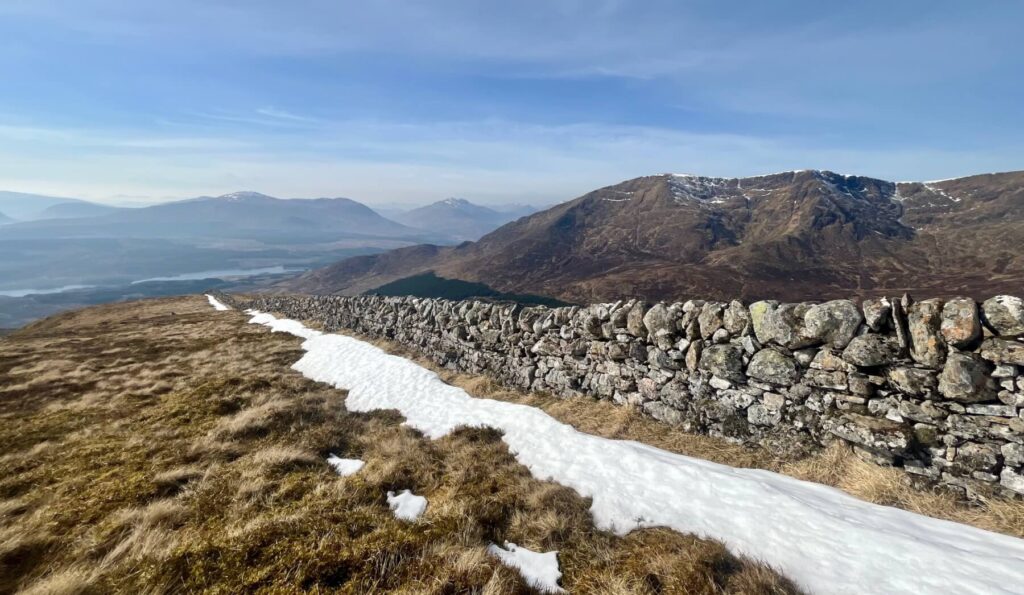
Few ascents are made from the Spey Valley to the north or Glen Roy to the west, this being remote and damp country. However, some do approach from Moy on the shores of Loch Laggan to the south, as this is the shortest route up the mountain. There isn’t much of a path, although the remarkable drystone dyke of the Moy Wall is a sure guide. This is a route favoured by skiers as the wall attracts a reliable build-up of snow. Creag Meagaidh is a mountain much-favoured by ski-tourers.
Coire Ardair is the showpiece of the mountain, a dramatic corrie shaped by ice and all the better for its secretive location, revealed in tantalising graduation on the approach along the river. The jewelled lochan is surrounded by a cirque of forbidding crags. In summer these are damp and vegetated, which makes them an ideal place for rare alpine plants to thrive.
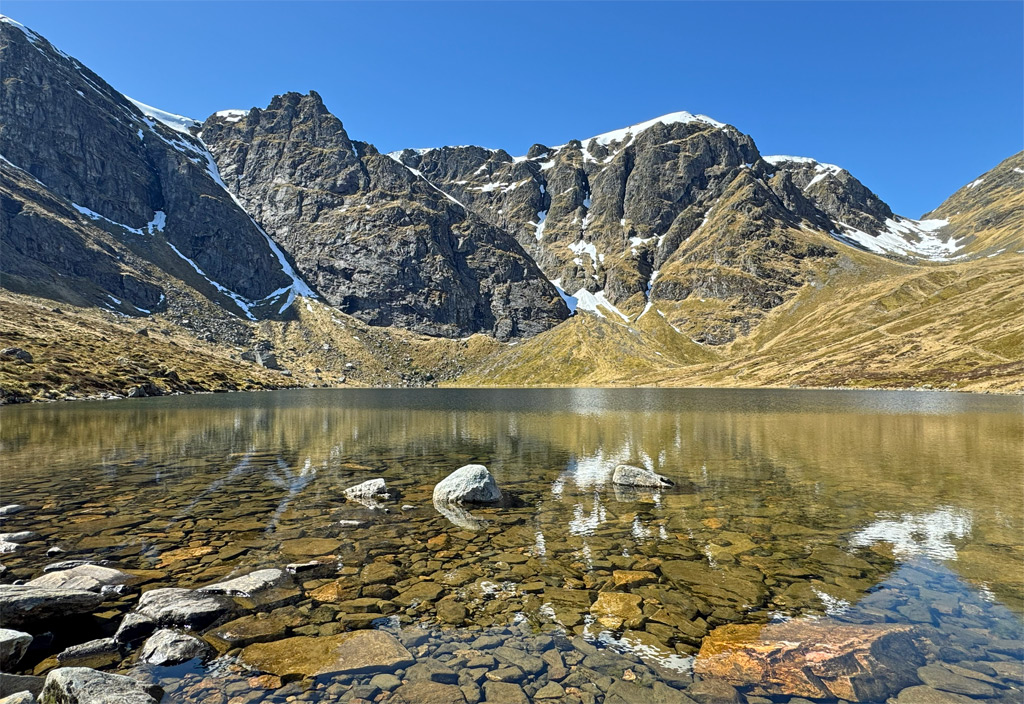
Move forward to the winter, and these crags provide one of the finest climbing grounds in Scotland, with the lochan often being frozen for five months of the year. Above it, Pinnacle Buttress stands on the south side, and the precipice swings round to the Post Face, named after its three pronounced gullies that define the crags. Apparently, there used to be a rudimentary climbers’ hut at the foot of Pinnacle Buttress, which was quite difficult to locate – possibly because it was often buried in snow!
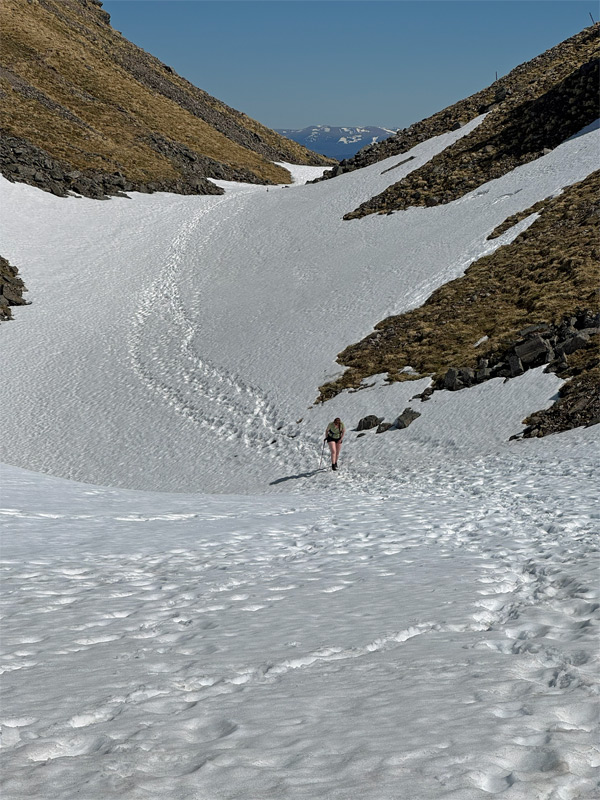
While many consider Creag Meagaidh to be a winter mountain, it is not necessarily out of bounds to suitably equipped walkers; the major hazard is the risk of avalanche, particularly in Coire Ardair. The Scottish Avalanche Information Service produces risk reports throughout the season. Nevertheless, the ascent from the lochan to The Window can be easier under moderate snow as, in these conditions, the pesky scree and boulders are smothered.
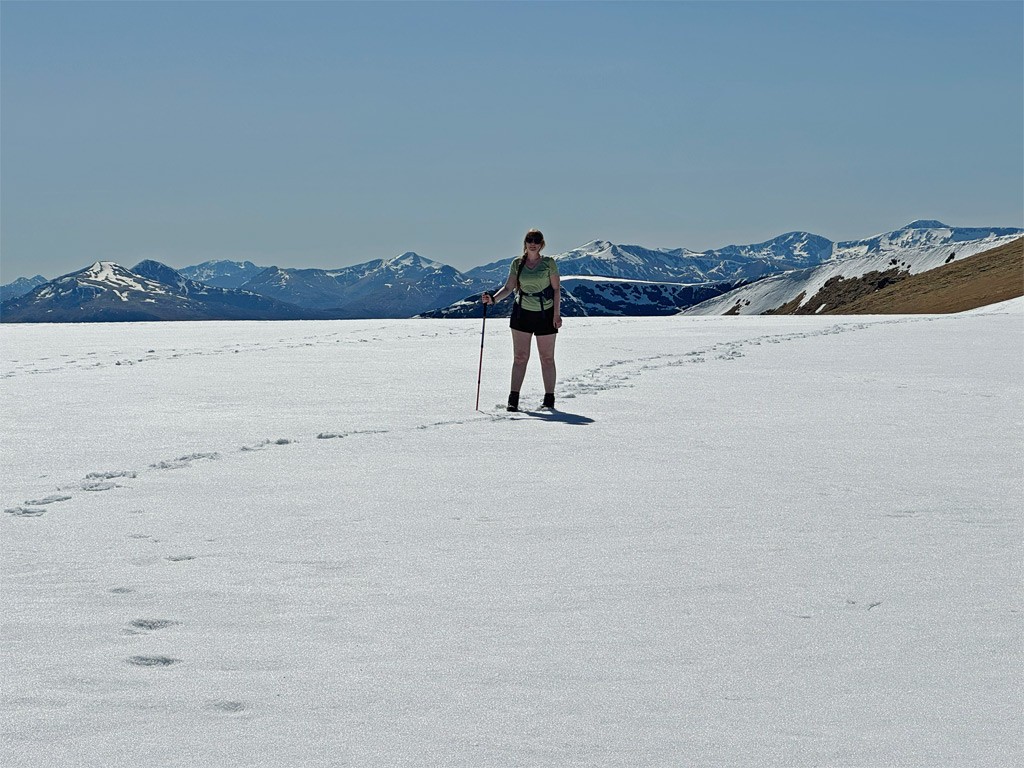
Once above The Window, there is no difficulty in attaining the summit plateau, another highlight of the mountain, being densely carpeted in the delightfully named woolly-fringe moss heath, which is equally delightful to walk on. Whilst revelling in its springy support, look out for the internationally important numbers of Dotterel, one of Britain’s rarest birds, which nest on the plateau from the spring.
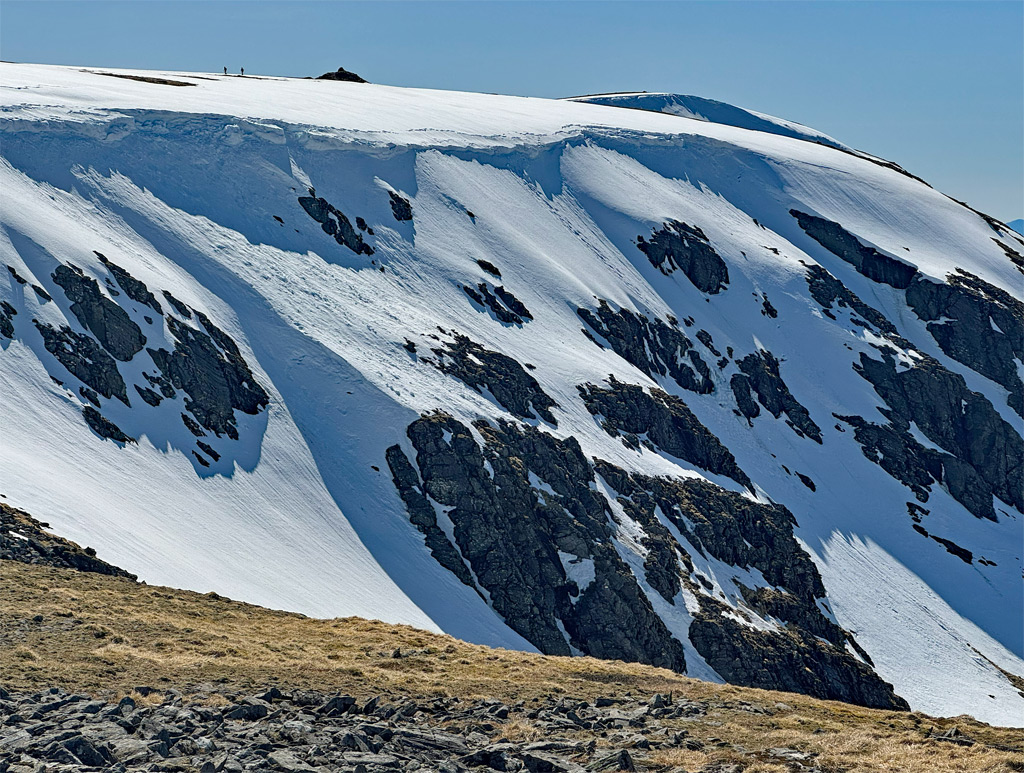
Prior to reaching the summit, your attention will be drawn by the sight of a curious cairn built on a sizeable earth mound. It is known as Mad Meg’s Cairn, and the folklore is that under it lies Mad Meg, a suicide victim who was denied a churchyard grave. There is no known evidence for this tale, and the name Meg is surely too much of a coincidence being on Creag ‘Meggie’. However, on a visit in 1894, no less than Sir Hugh Munro passed the cairn and declared it to be under construction by a ‘local farmer of unsound mind’.
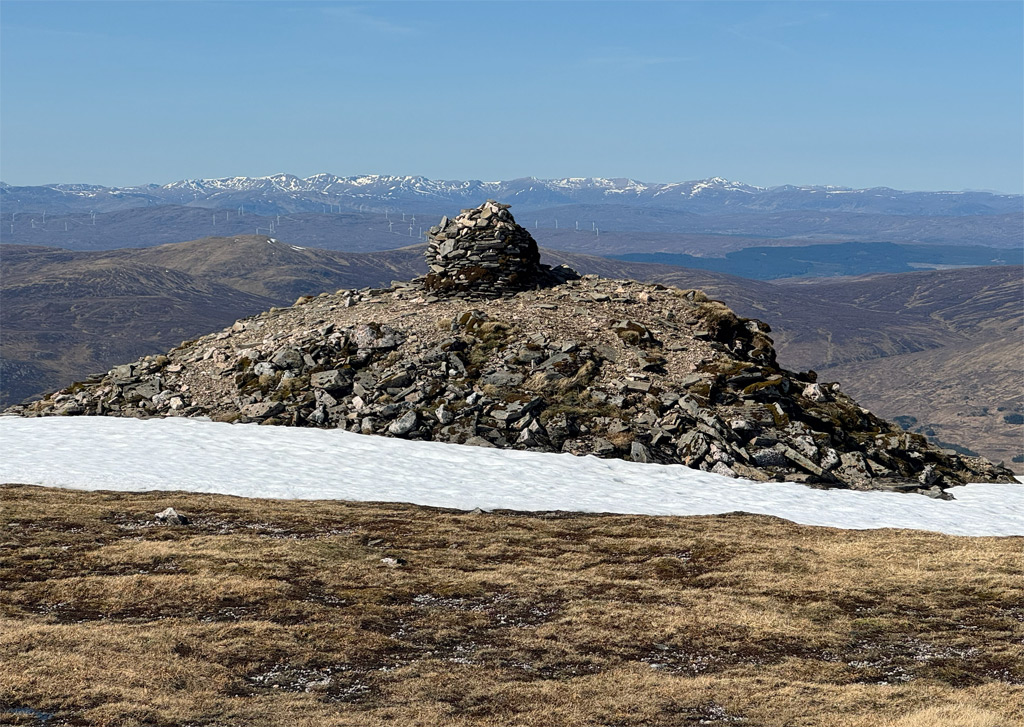
Evidence exists of one Joseph McLaren, whose brothers farmed at Moy. Joseph was, in the language of the day, an ‘imbecile’ and unemployed. There are suggestions that he occupied a summer shieling high in the Moy Corrie, from where he could carry out his construction project, for whatever purpose he deemed necessary. It’s a fascinating story, and for more information, read Leen Volwerk’s research in the 2013 edition of the SMC journal, available to download online.
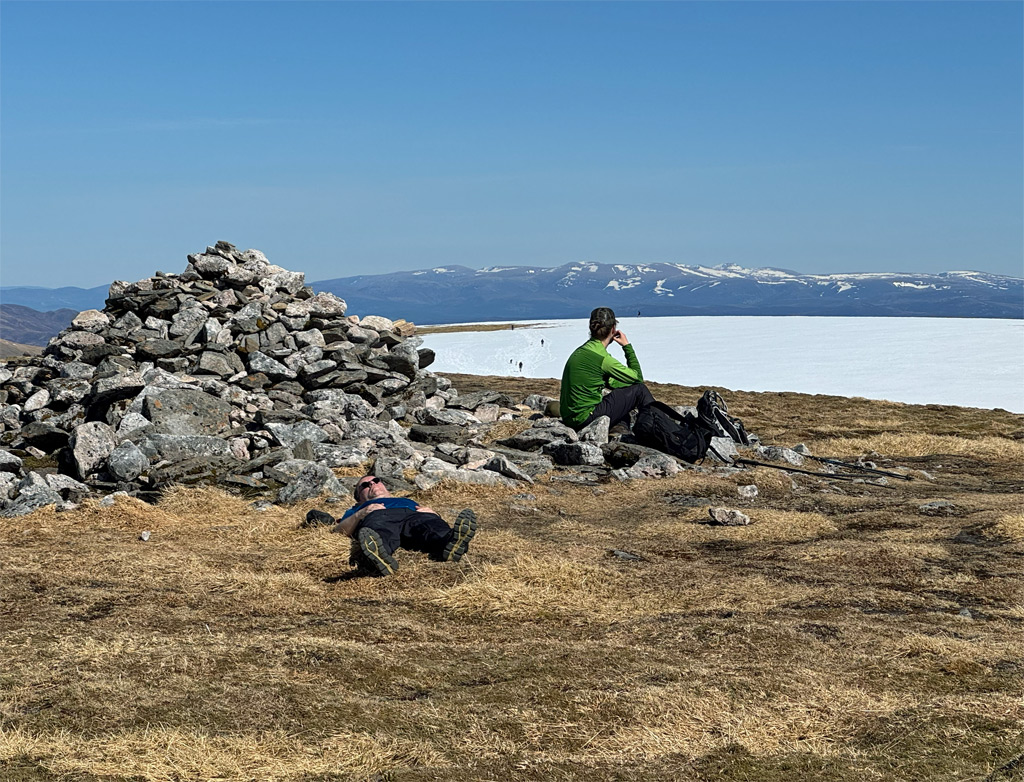
The central location of Creag Meagaidh and its relative isolation from other mountain ranges result in a distant, although comprehensive, wide-ranging view of the Highlands; it truly is a vast panorama.
Worthy Rating: 74
Aesthetic – 21
Complexity – 14
Views – 16
Route Satisfaction – 14
Special Qualities – 9