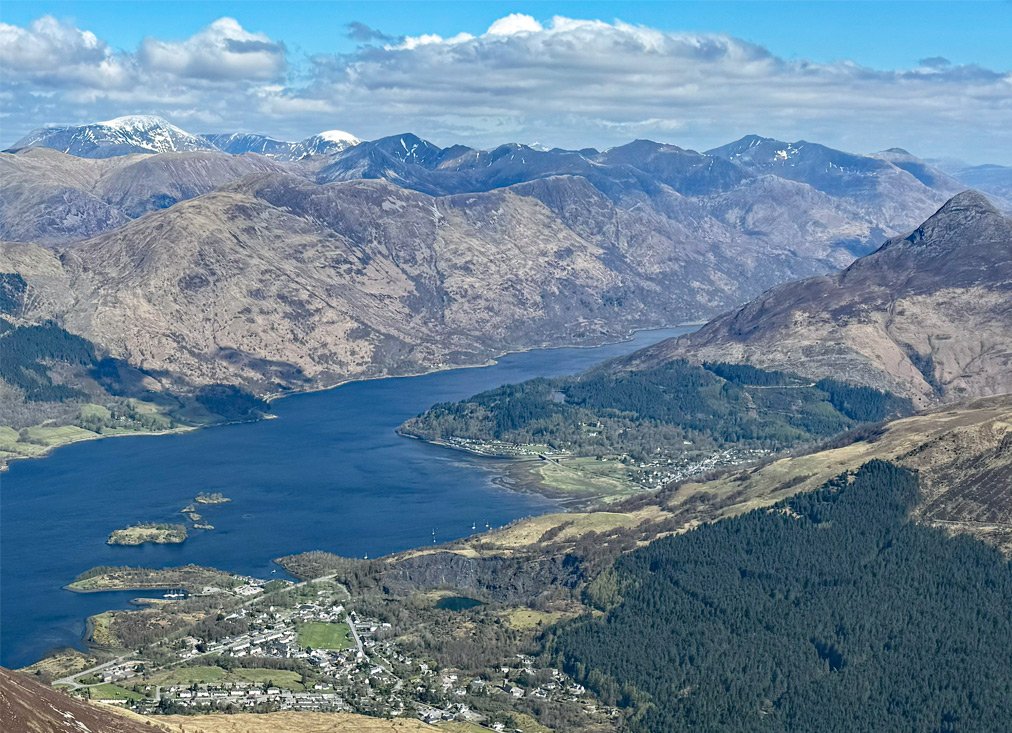
The Mamores are one of the great ranges of the Highlands, a monumental group of ten Munros, with Binnein Mor being the mother mountain and highest summit at 3707ft (1130m). It’s name aptly translates as ‘big peak’ and many authorities regard Binnein Mor to be the finest of the range.
The full traverse forms a magnificent expedition for the very fit walker. Whilst the distance of twenty-two miles is potentially manageable for some mortals, it is the more than eleven thousand feet of ascent that is the limiting factor. Incredibly, hill runner Finlay Wild has achieved this in just 4hrs 38mins. The customary walking time is around fourteen hours.
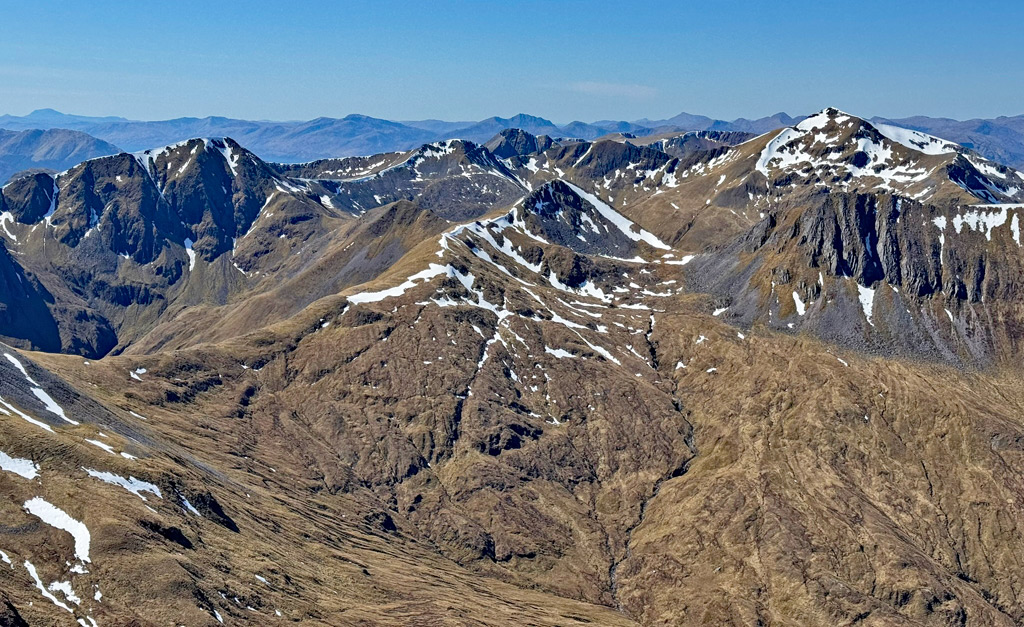
The ‘Mamores Ten’ is convoluted in places and does involve some out-and-back walking, plus two outlying Munros. Consequently, to split the effort into manageable chunks, the whole expedition is commonly divided into three separate outings. Our choice of Mamore Worthies also derives from this division, with this particular chapter being devoted to Binnein Mor itself, with honorary mentions for its subsidiary and outlying satellites.
Binnein Mor lies at the eastern end of the main ridge, with a footstep into the wild, rugged landscape that flows to the north and east, crossed only by the extraordinary Rannoch Moor railway line. Through this relative isolation, the mountain is reputedly one of the least ascended of the Mamores, despite its superior altitude.
The map below can be moved around and zoomed in or out to change the scale:
Unlike its compatriots, Binnein Mor is usually climbed from Kinlochleven rather than Glen Nevis, much of this being due to far more defined and less boggy paths. Indeed, it is this bogland that gives rise to the Water of Nevis, not called the River Nevis until below the famous Steall Falls. If you do approach this way, beyond the falls you will suddenly leave behind the tourist hordes to continue on a solitary and frequently damp ascent.
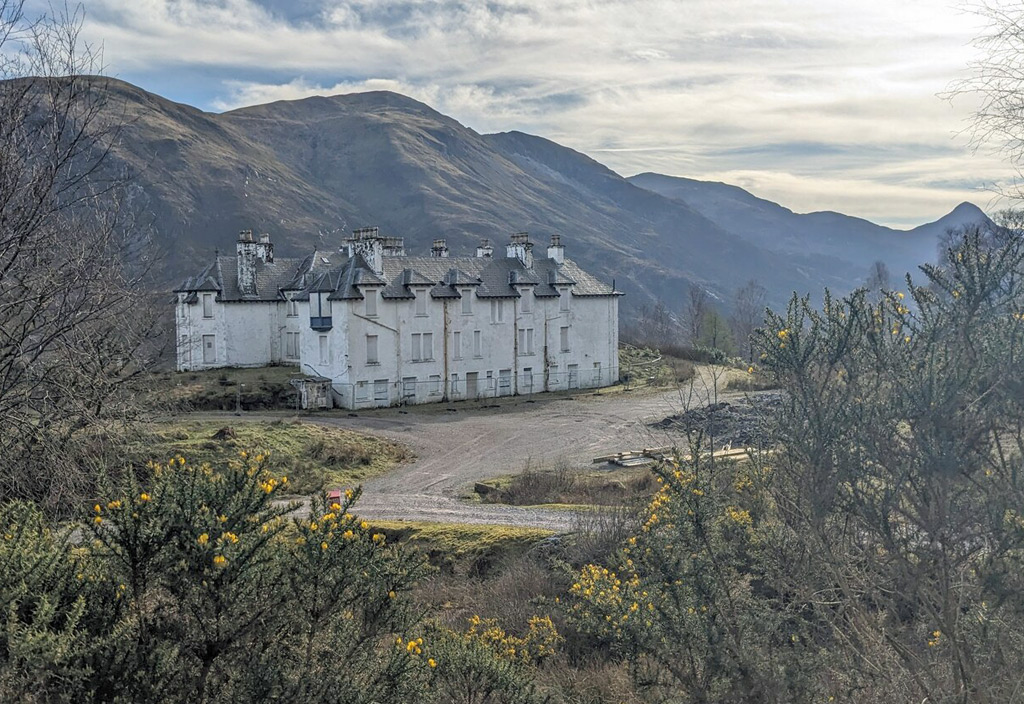
On most maps, emblazoned in large capital letters, is ‘MAMORE FOREST’, a large clue to the land use as a sporting estate. The Mamore Estate covered some 45,000 acres during its Victorian heyday. As a base for visiting gentry, the imposing Mamore Lodge was built at the end of the 19th century, at an altitude of 650ft above Kinlochleven, the lodge twice playing host to Edward VII.
Nonetheless, stalking does still take place on the hills, the Mamore Estate being part of three estates owned by Jahama Highland Estates, who are part of the giant GFG Alliance Group, whose interests include steelworks and energy industries; of most relevance in this area is their ownership of the Lochaber aluminium smelting plant.
A network of stalkers’ paths was constructed across the Mamores, and it is the utilisation of these that assists admirably with ascents made from Kinlochleven. Some of these paths remain in use by the Ghillies and their guests, as the estate offers deer stalking holidays, costing around £5,000 per week for accommodation and £720 per stag shoot.
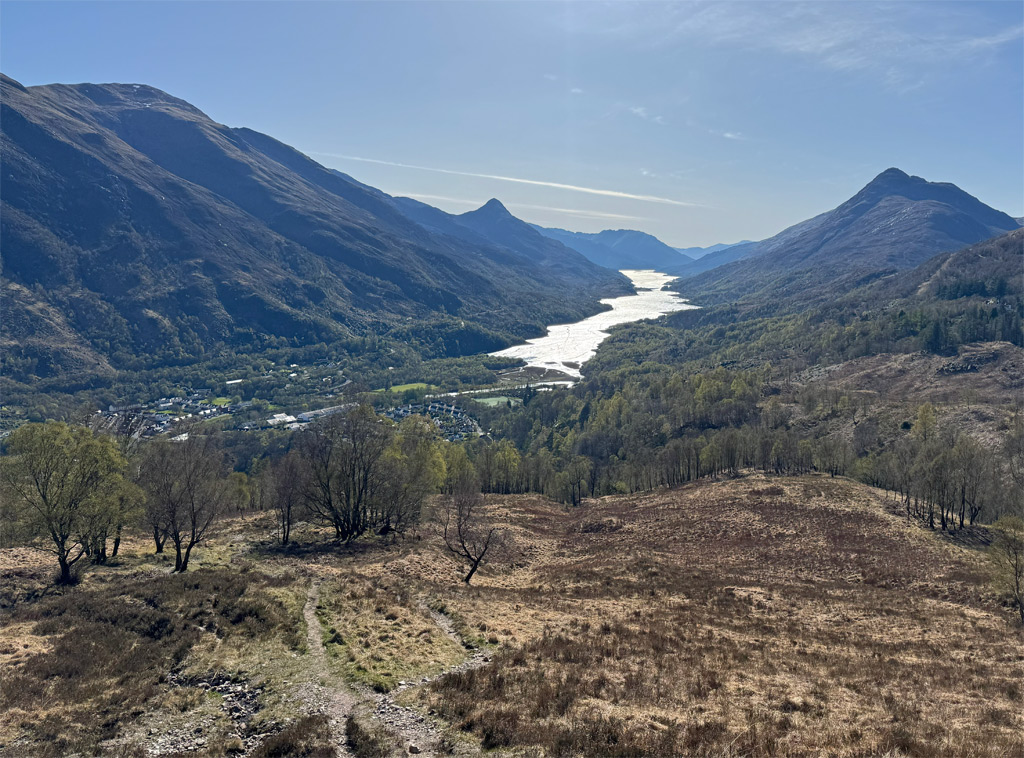
Kinlochleven is an ostensibly remote village, yet its size and range of amenities come as a surprise to many visitors. The population is around eight hundred, although it formerly topped one thousand when the Kinlochleven aluminium smelter was in operation. This opened in 1907, and the associated hydro-electric plant, which provided the power, made the village famous for being the first in the world to have every home supplied by electricity. The smelter closed in 2000, and the village is now very much managed by a community trust whose purpose is to enable the village “to develop, thrive and be sustainable”.
Tourists come to see the Grey Mare’s Tail waterfall, one of six so named in Scotland, and you can too, as it is only a short diversion off the path to Binnein Mor. Otherwise, our walk goes steeply through woodland to reach open ground as the angle eases.
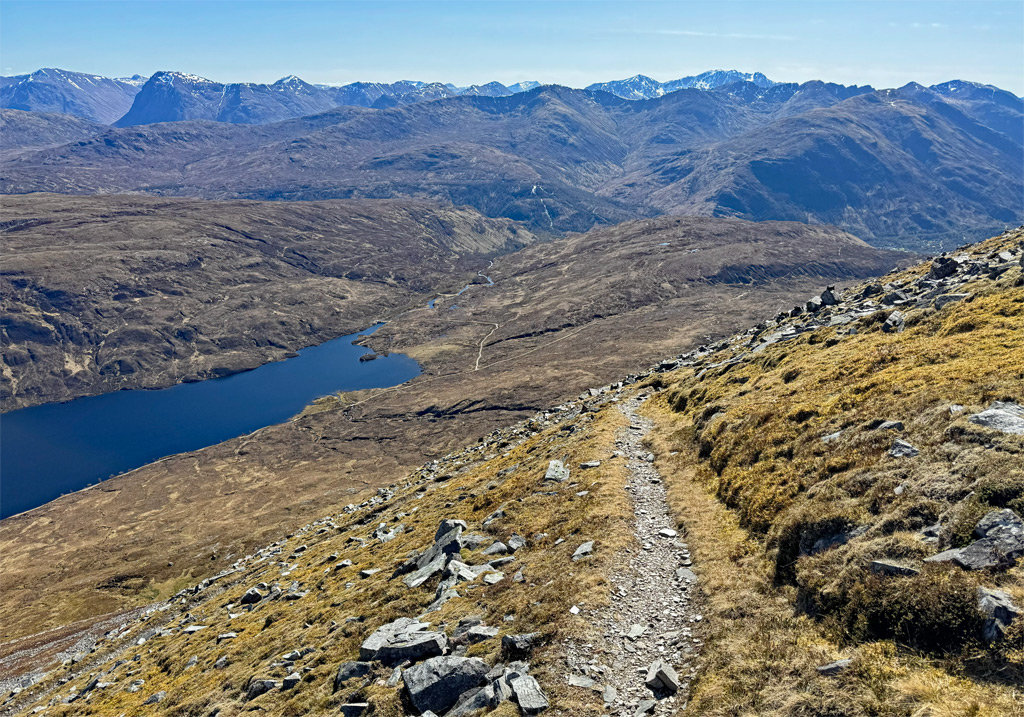
The primary route heads for Loch Eilde Mor, but crosses the access track to the loch and then climbs around the southern shoulder of Sgor Eilde Beag. As the corner is turned, look out for a small cairn and narrow path diverging to the left. This is a beautifully engineered stalker’s path that takes the sting out of what would be a steep and tiring ascent to Sgor Eilde Beag, from where the views of Sgurr Eilde Mor are outstanding.
Keeping to the rim of the corrie, a very pleasant walk leads on to the 1062m spot height, unnamed on maps. Munro’s Tables call it Binnein Mor South Top and, upon reaching it, the ridge to the main summit bursts into view, along with a staggering panorama of the Mamore range. The ridge itself is a delight, arriving with mounting anticipation at the airy summit.
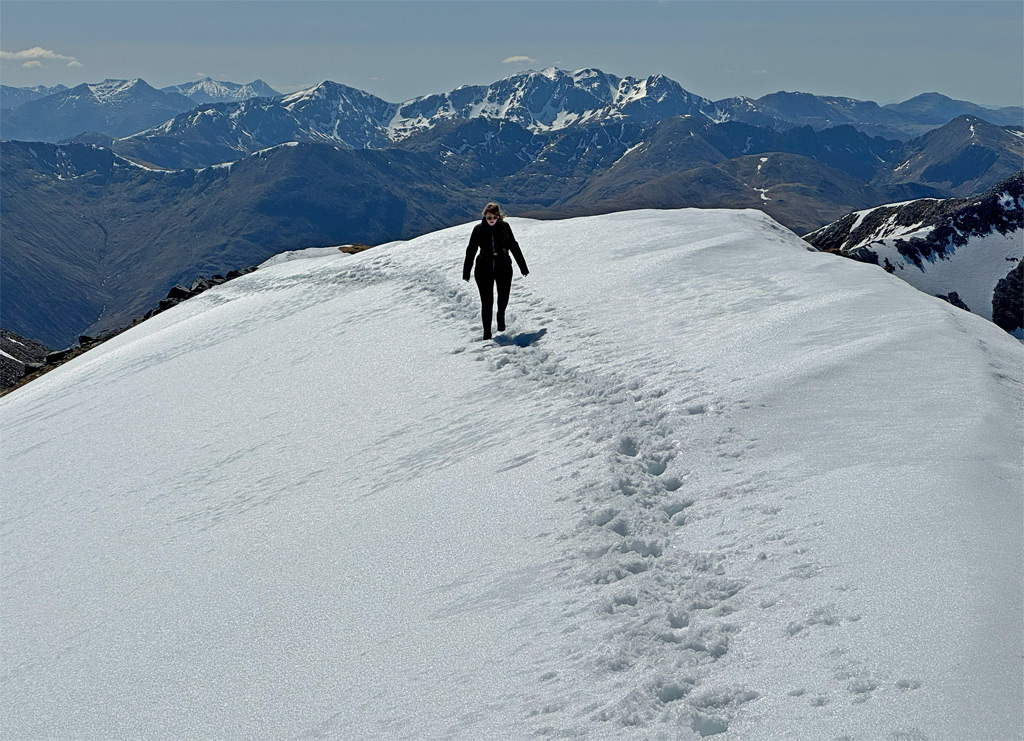
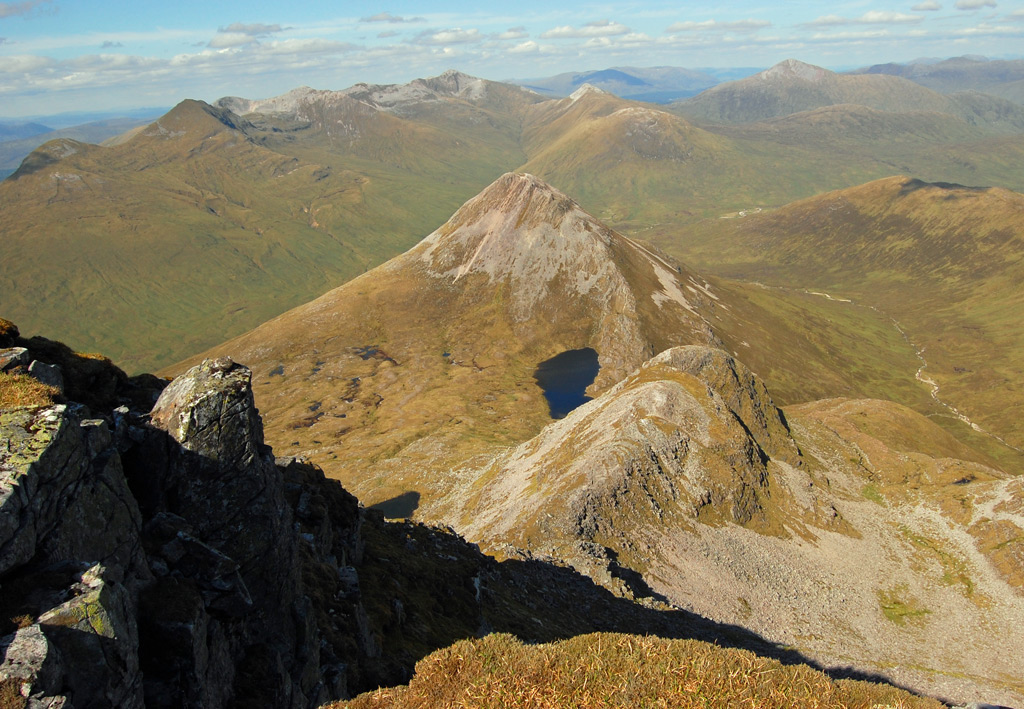
There is a slightly lower top beyond, along the narrow crest, although it is worth a visit to enjoy the subtle change of view, particularly looking down the fine northeast ridge to the pointy peak of Binnein Beag.
If you encounter other walkers on top, why not impress them with an interestingly nerdy fact I picked up from the Walking Britain website? Binnein Mor is one of the fifty-six Munros higher than Snowdon. Why anyone ever researched this, I don’t know, but I did check its accuracy in my copy of Munro’s Tables. It is correct, although what surprised me most was that Munro’s Tables actually converted to metric heights in 1974, rather earlier than I expected. Clearly, Munroists are not the stuffy old stick-in-the-mud types we might think they are!
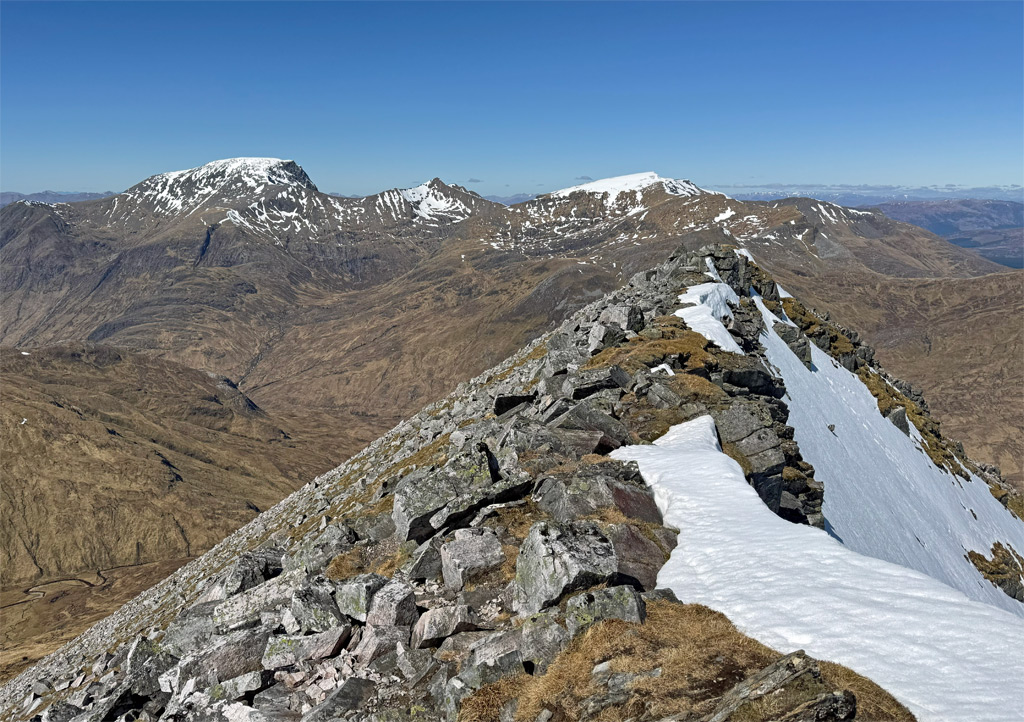
For those wishing to vary the return route to Kinlochleven, stalkers’ paths once again provide the opportunity. Heading back towards Sgor Eilde Beag, a path drops down into the corrie from just before the shallow saddle prior to the rise to the summit. In spring, snow lingers long on this side (see photo below), so the path may not be visible as it weaves down to Coire an Lochan. Then, from near the outflow, it continues beside waterfalls before slanting down to Loch Eilde Mor.
Once at the loch, the main track is reached, which subsequently rejoins the outward ascent route. This track was created when Loch Eilde Mor was converted from a natural stretch of water into a reservoir by the building of a dam in 1916. A five-mile pipeline was laid out to boost supply to the Blackwater Reservoir for use in hydro-electric power production. Much of the labour was carried out by 1,200 German prisoners of war housed in a POW camp at Kinlochleven. Loch Eilde Beag is still used to produce power, with a recent scheme being established in 2017.
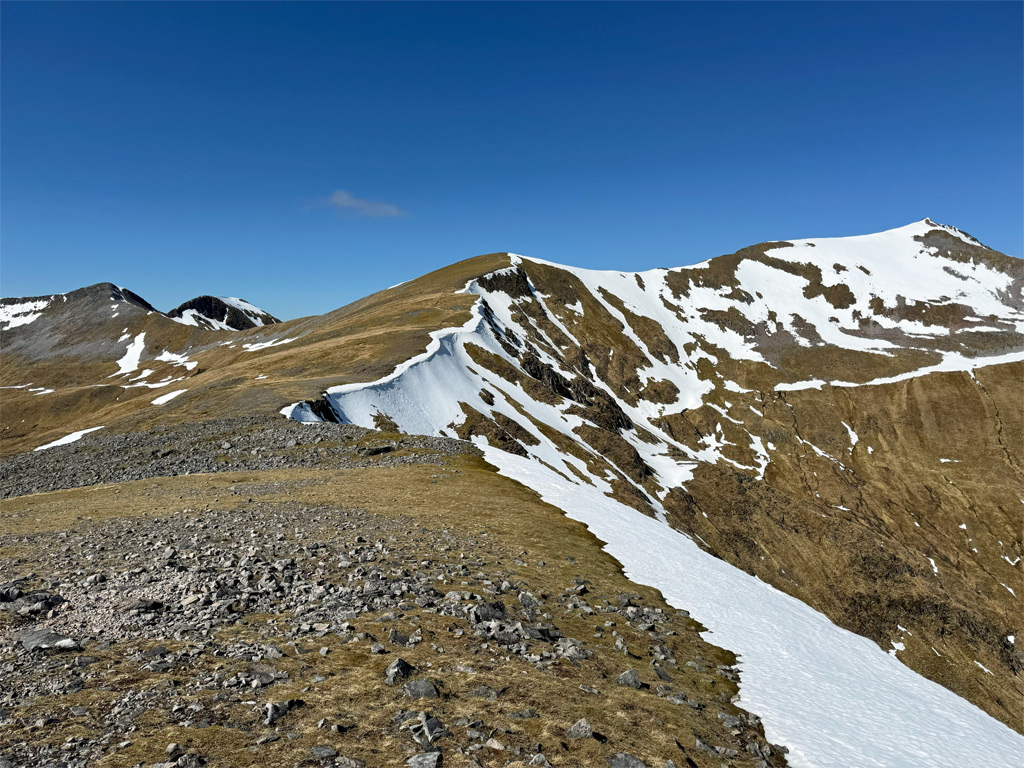
Na Gruagaichean
Adjoins Binnein Mor, and simply diverting to its summit is an easy addition to the walk. The mountain has two tops, although the highest at 1056m is the nearer one, nevertheless, it is still lower than Binnein Mor South Summit. Such are the oddities of Munro classification. As an alternative descent (or ascent) for Kinlochleven, there are two possibilities. One is to head south from the main summit along the ridge to Leachd nah-Aire, before plunging west down the rough, pathless slopes towards Mamore Lodge. This is the short way, which is its only recommendation.
If the north top of Na Gruagaichean is climbed, then follow on along the main ridge to the col from where a particularly wayward old stalker’s path can be found (and easily lost), taking an initially leisurely descent into Coire na Ba, which then leads down to Mamore Lodge.
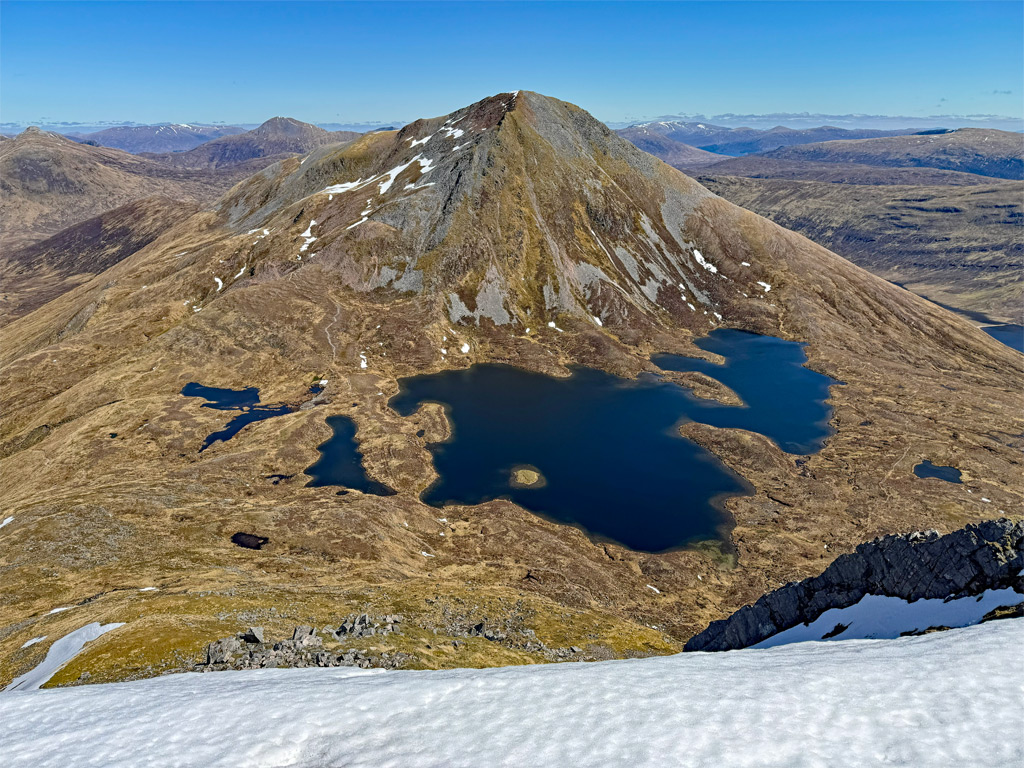
The Outliers
Sgurr Eilde Mor and Binnein Beag are stunningly conical hills, both being Munros yet dwarfed by Binnein Mor. That doesn’t mean they are necessarily easy ascents, and the hills are often considered better to look at than to climb. However, Munro baggers don’t have the luxury of looking only and are therefore required to tackle their scree-ridden slopes. Doing both peaks together does involve losing 400ft of altitude, although this is compensated for by the wonderfully remote feel of the surroundings.
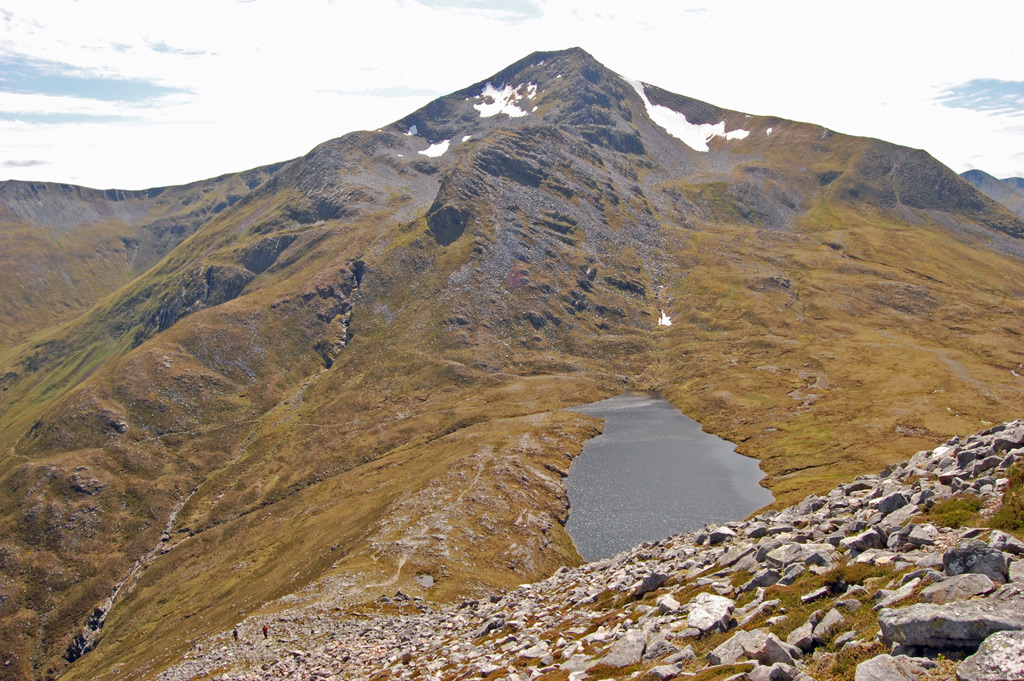
The natural link to Binnein Mor from Binnein Beag is via the twisting northeast ridge, Sron a’ Gharbh-Coire, which is a fine grade 1 scramble, tricky only when wet or icy. Alternatively, circling around to the north ridge (or being pedantic, north-north-west) makes for a more temperate ascent.
Whether you choose to revel in the (relatively dry) amenable paths on Binnein Mor as a sole objective, or add in the neighbouring Munros, a fine day in the majestic Mamores is guaranteed.
Worthy Rating: 77.5
Aesthetic – 22.5
Complexity – 13
Views – 19
Route Satisfaction – 15
Special Qualities – 8
A really interesting read – I have never been up any of these easterly Mamores (I think put off by the sea level start), but you have inspired me!!