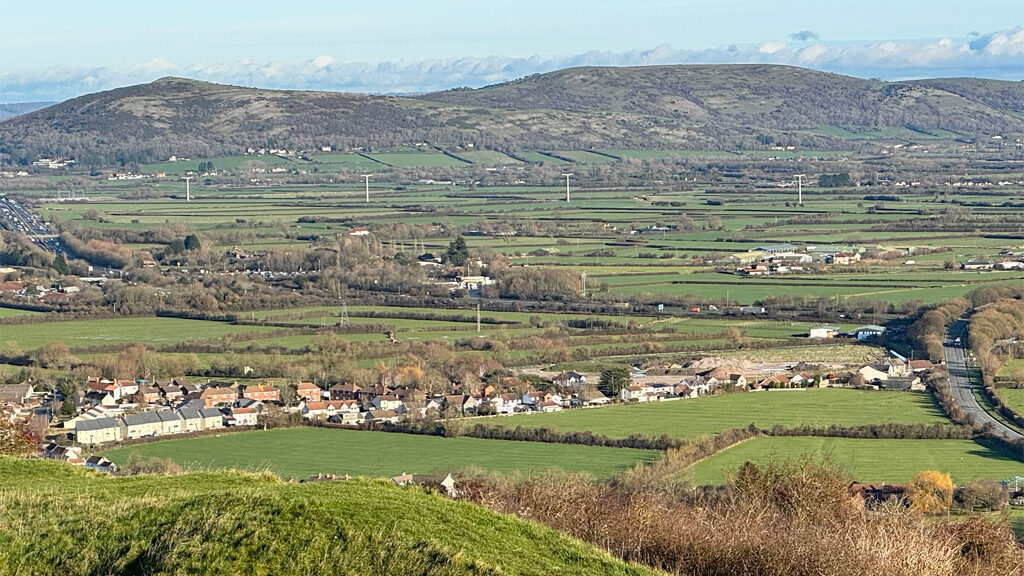
Crook Peak & Wavering Down: A Mendip Motorway Stop
The Mendip Hills form a pronounced upland plateau serving to distract the outdoor enthusiast driving though Somerset on the M5 motorway. A closer inspection reveals that, despite extending for some fifteen miles and rising above the one-thousand-foot contour in several places, on the whole the Mendips lack individual definition and are invaded by a profusion of roads, neither of which is conducive to Worthy recognition.
Nevertheless, for those travelling the M5, an exception is right under (well, above) their nose in the presence of a rugged prominence called Crook Peak. Admittedly it is no mountain and some might consider it subordinate, driving on while turning their thoughts to greater ranges. However, in the Worthy world, altitude is of minor consequence, with character, enchantment and the satisfaction of the ascent bearing more weight. In these factors Crook Peak and its neighbour, Wavering Down, warrant valid attention.
Nonetheless, the Mendips are a popular visitor attraction, more for its famous limestone gorges and caves than the network of footpaths that cross the hills. Much of the plateau is agricultural land, enclosed by walls and hedges, except that is for our particular area of interest, where pleasingly short turf and an open aspect characterises the western fringe of the range.
The average altitude of the Mendip plateau is around eight hundred feet, although our two hills are well below that height, yet gain distinction by standing apart, their separation achieved through the col linking them to the main ridge being the lowest point of the Mendip Hills. This is augmented by our outpost rising from a much lower level, the wetlands of the Somerset Levels lapping at its foot, barely twenty feet above sea level.
The map below can be zoomed in or out to change the scale:
The National Trust recognised the importance of protecting this unspoilt corner of the Mendips, which had long been lands of the Mordaunt family and through an appeal, grants and bequests bought the Compton Bishop Estate in 1986. Other than the village of Compton Bishop, all the area in the scope of our suggested walk is on National Trust land and within a Site of Special Scientific Interest, itself a part of the Mendip Hills Outstanding Area of Natural Beauty (now termed National Landscapes). In addition, a recent designation in 2023 by Natural England has created the Mendips National Nature Reserve, part of a new initiative to create twenty-five sites known as the King’s Series to commemorate the coronation of King Charles.
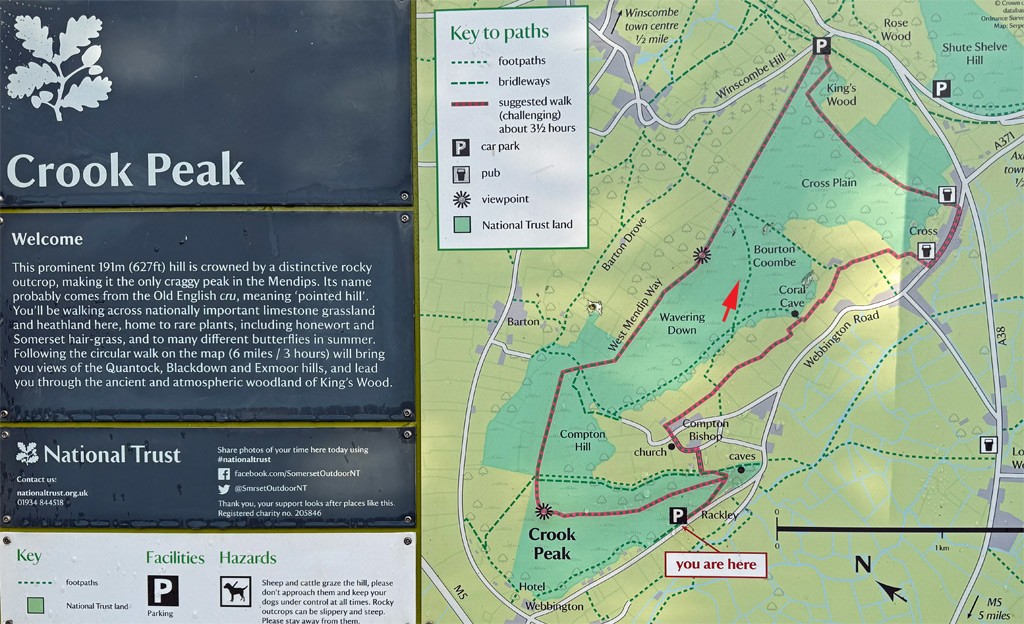
A glance at the map above indicates the abundant access points to the hills, although the two main parking areas are Webbington Road layby (marked ‘you are here’) and King’s Wood. If following the National Trust’s suggested walk (the red line), the least interesting part is the low level stretch between Compton Bishop and Cross village and, for those concentrating on the hills, the path cutting across via the red arrow is the option to take. For those that do go through Cross, look out for a garish pink house which was the home of comedian Frankie Howerd and named Wavering Down. In Frankie’s day the house was a softer shade of pink and the latest owner’s choice has caused quite a stir in the village.
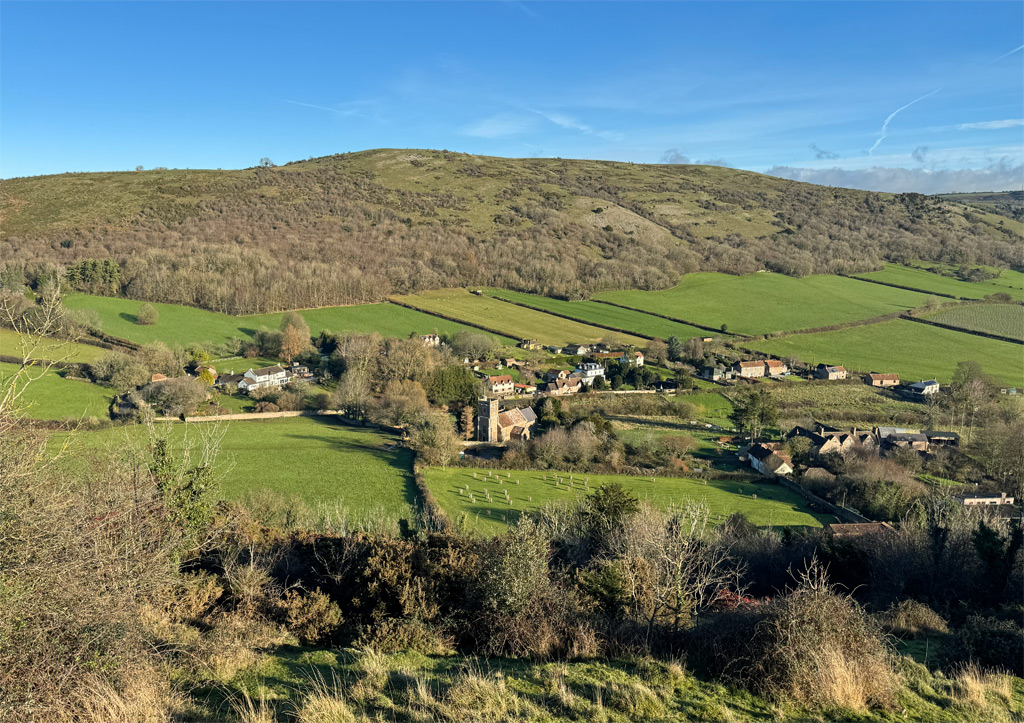
If commencing your walk at King’s Wood there is a small height advantage, although at 80m above sea level this is lowest part of the Mendip ridge. King’s Wood is one of last remaining parts of an ancient woodland within the former medieval Mendip Royal (hunting) Forest.
For those beginning at Webbington Road, I would suggest taking an anti-clockwise circuit, as interest will mount with each progressive step. Start by rounding the southeast ridge of Crook Peak and wandering through Compton Bishop village, then cross the fields and take the slanting path up through woodland (muddy when wet so in such conditions better going up), before emerging into open country.
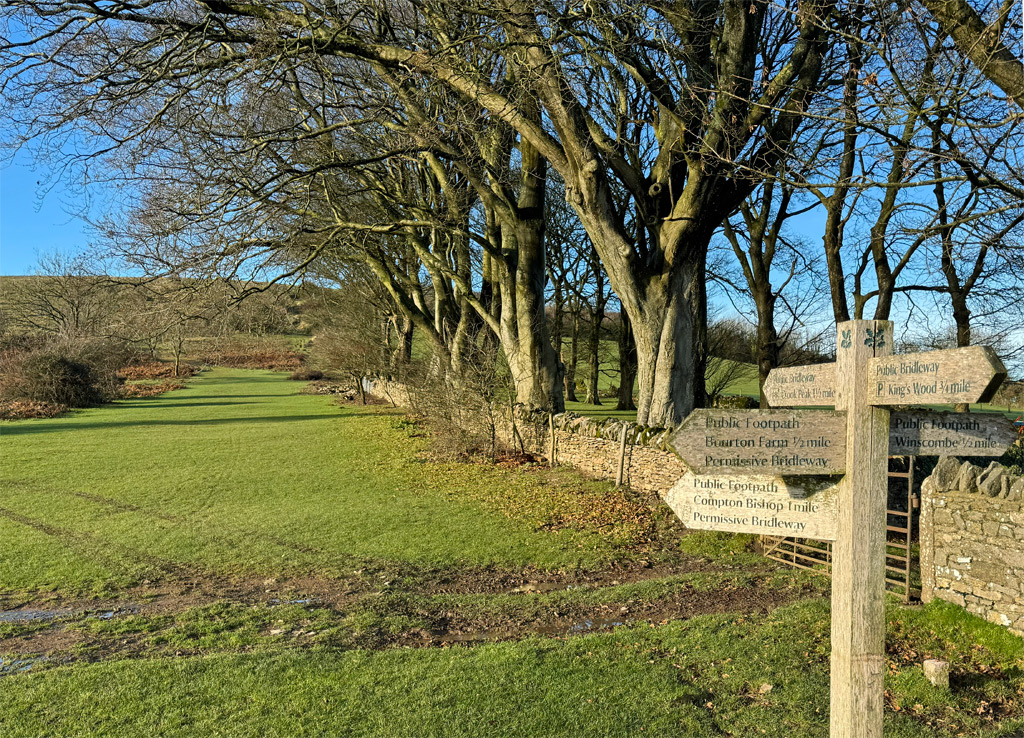
On reaching the ridge at the appropriately named Hill Farm, the path from King’s wood is joined (pictured above). A pleasant short stroll leads to the summit of Wavering Down at 692ft (211m), which is relatively flat with a trig pillar at the eastern end. It can be busy, as the out and back from King’s Wood is a popular walk and particularly rewarding, supplying great views for little effort for the local population of this part of Somerset (interestingly there is no demonym for those born in Somerset as I could have saved space by just calling them Zummerzetties or whatever). The Mendip hills head off to the east, while turning south the scene is dominated by the Somerset Levels, guiding the eye to the Quantock Hills.
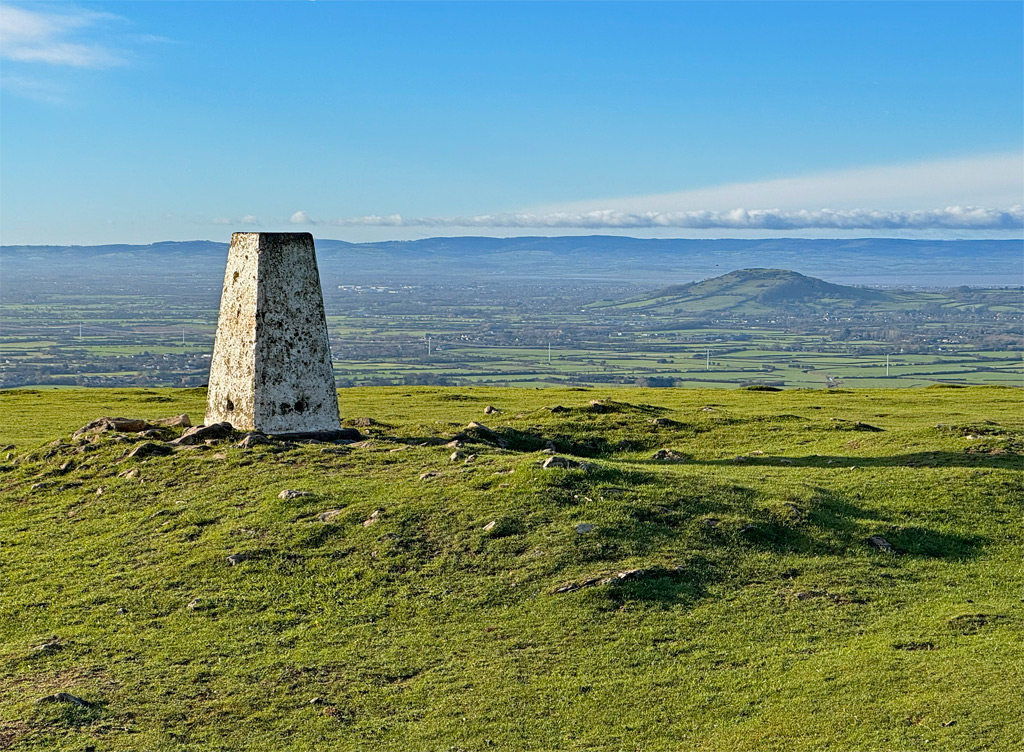
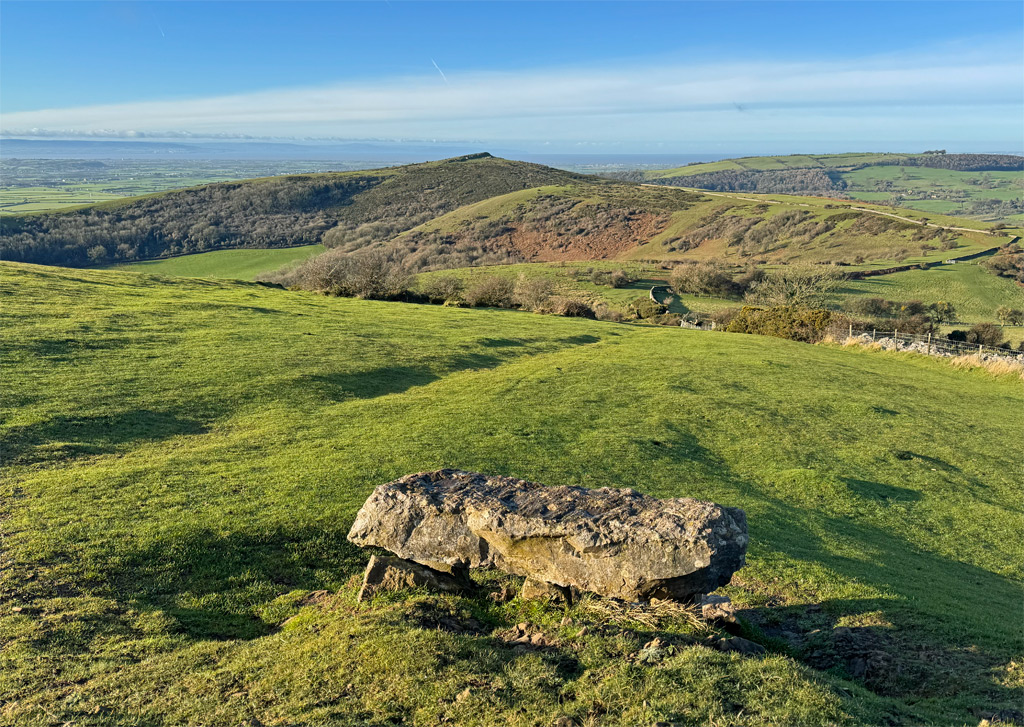
The western and northern hemispheres are better appreciated when continuing on towards Crook Peak, where on the initial descent a large block of limestone is passed, like a mini dolmen, and known as the stone bench. Crook Peak looks delectable from here and the walk to it across Barton Hill is blissful on the short grass that so typifies limestone country.
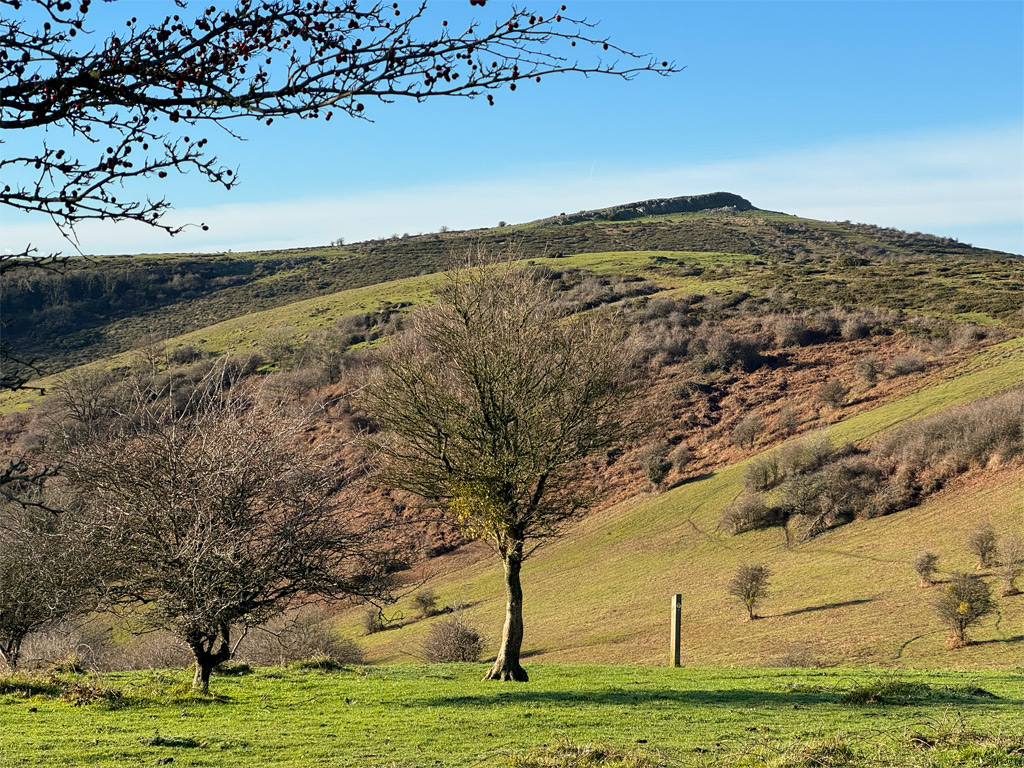
Our steps are accompanied by a drystone wall recently reconstructed by National Trust volunteers and forming a boundary along the ridge crest. This drops down to the north as we rise onto Crook Peak, which has very few walls or fences although, unbeknown to the walker, there are ‘virtual boundaries’. These are only encountered by the herd of sixty cows that graze the hill, wearing solar powered GPS collars that emit a weak electric current should any bovine stray beyond the invisible barriers.
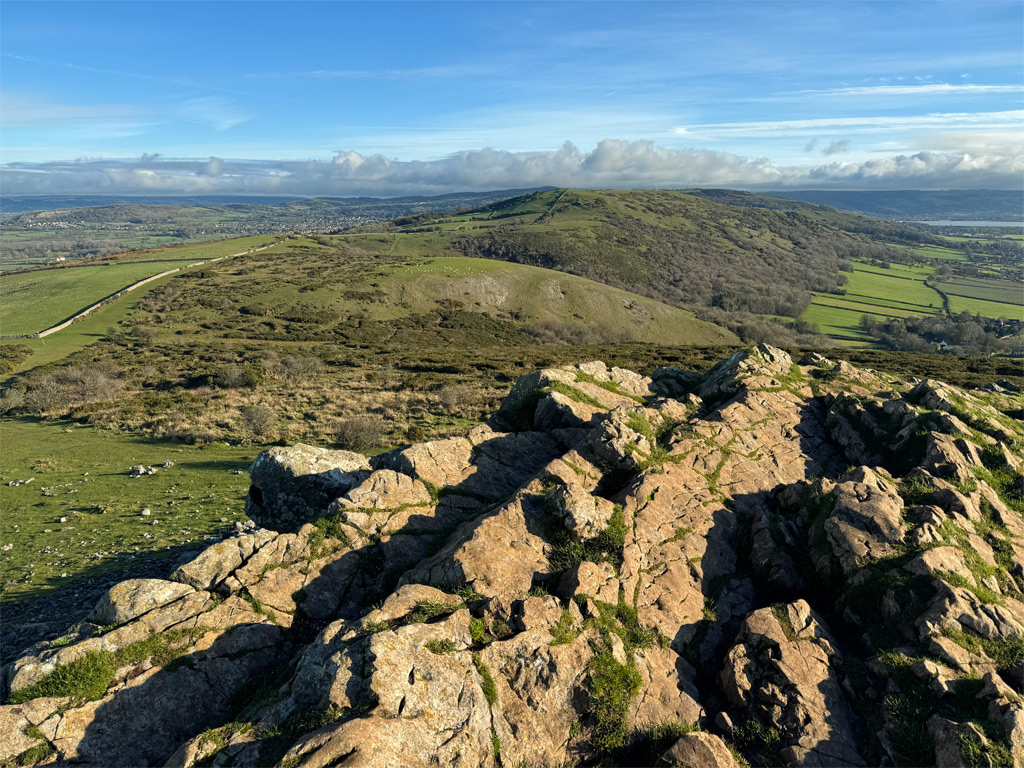
And so to the summit of Crook Peak at 627ft (191m), which may be lowly but who cares when it is this exhilarating. The top is so rocky that it doesn’t require a cairn and the strata slants down at a thirty degree angle, forming an abrupt escarpment that provides a flourish to the final ascent. The top is a glorious place to be and the views are even more extensive than on Wavering Down. Unsurprisingly the hill once once used for beacon fires, as far back as the 1500’s to warn of invasion by the Spanish Armada. From here the eye casts west across the Bristol Channel to South Wales, then turns to gaze beyond the isolated lump of Brent Knoll to the hills of Exmoor. Our lofty perch also grants a unique perspective of the steady bustle on the M5 motorway.
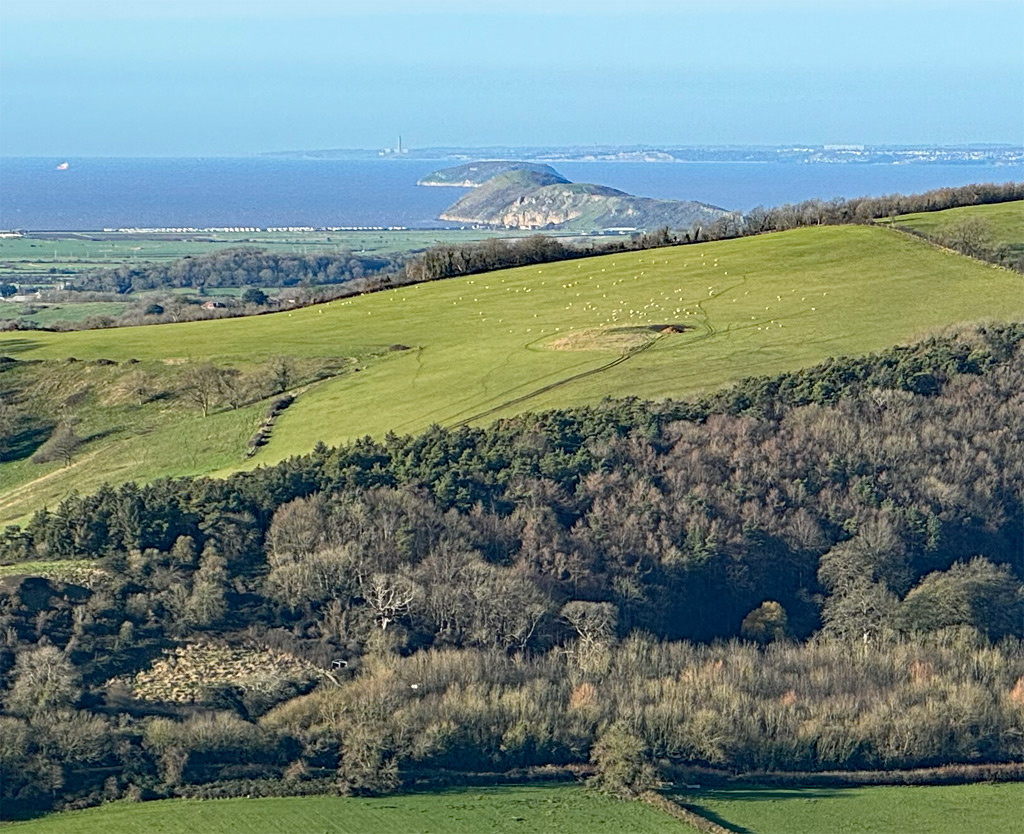
The M5 may well be your means of travelling home, although firstly there is the sublime southeast ridge to descend, a most agreeable conclusion to our splendid two-hour walk.
However, if you have more time to explore the Mendips, then an Honourable Mention goes to Cheddar Gorge, which is utterly spectacular and the five-mile circuit of its rim is a fine walk, although the path doesn’t get as close to the edge often enough for full appreciation. Also you may head up the highest point of the Mendips at Beacon Batch, the summit of Black Down, an invigorating heathland roamed by Exmoor Ponies and with numerous historical points of interest. Finally, you could count the endless rows of static caravans stringing the coastline, before making a sprightly ascent of the craggy Brean Down, to behold the splendours of the Holm islands and the somewhat less splendiferous juxtaposition of Weston-Super-Mare!
Worthy Rating: 64
Aesthetic – 19.5
Complexity – 11
Views – 14
Route Satisfaction – 13
Special Qualities – 6.5